Designing with Award and Trophy Color Icons: A Practical Guide for Modern Visual Communication
The Role of Symbolic Icons in Contemporary Design
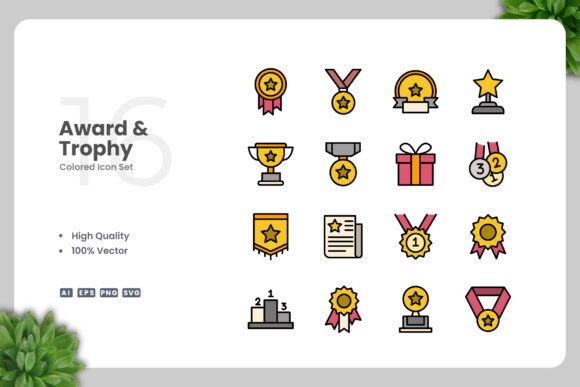
Across digital and print media, few visual elements carry as much inherent meaning as award and trophy icons. These symbols instantly communicate recognition, achievement, excellence, and success without requiring a single word of explanation. When rendered in color and built on a clean, vector-based foundation, award and trophy color icons become even more powerful tools for designers, educators, marketers, and content creators. Their ability to convey emotion and status makes them indispensable in contexts ranging from mobile app interfaces to educational infographics, from corporate presentations to social media campaigns.
What sets high-quality award and trophy color icons apart is not merely their subject matter but the precision of their construction. Icons that are designed with simplicity and scalability in mind allow for seamless integration across platforms, resizing without loss of fidelity, and effortless customization through widely available vector software such as Adobe Illustrator and CorelDRAW. This adaptability ensures that a single icon set can serve a website, a printed flyer, a book layout, and a poster campaign with equal effectiveness.
Vector-Based Precision and Scalability
The foundation of any versatile icon set lies in its vector format. Unlike raster images, vector graphics are composed of mathematical paths rather than pixels, which means they can be scaled to any size without degradation. A trophy icon designed for a mobile app button can be enlarged to fill a billboard without becoming pixelated or blurry. This characteristic is essential for professionals who work across multiple media and need one asset to perform universally. The inclusion of source files such as Ai, EPS Version 10, and SVG ensures compatibility with virtually any modern design workflow, while a PNG Transparency option provides immediate usability for those who prefer a raster fallback.
Color as a Communication Layer
Color adds a dimension of meaning that monochrome icons cannot achieve. A gold trophy conveys victory, a silver cup suggests second-place recognition, and a bronze award implies honorable achievement. When designers have access to award and trophy color icons, they can leverage these chromatic associations to reinforce messaging. Moreover, the ability to easily edit colors in vector software means that brand-specific palettes can be applied instantly. A company whose brand identity uses teal and orange can adapt a gold trophy icon to match those hues, preserving brand coherence across all touchpoints.
Simplicity and Clean Aesthetics
In an era of visual clutter, simplicity stands out. Clean icon designs avoid unnecessary details, intricate shading, or overly complex geometry. Instead, they rely on clear silhouettes, balanced proportions, and intentional negative space. This minimalist approach ensures that the icon remains legible at small sizes—critical for mobile interfaces and app icons—while also looking polished in large-scale contexts such as banners and posters. The beauty of a simple trophy icon is that it communicates instantly, regardless of the viewer's cultural background or design literacy.
Websites and Mobile Applications
User interfaces benefit enormously from consistent, recognizable iconography. Award icons are frequently used to denote achievement badges, leaderboard rankings, certification status, or milestone completions. In gamified learning platforms, for example, a trophy icon signals that a user has mastered a module. In e-commerce, award icons can highlight top-rated products or verified sellers. Because award and trophy color icons are available in scalable vector formats, they load quickly, render crisply on retina displays, and integrate smoothly with responsive design frameworks.
Books, E-Books, and Educational Materials
Publishers and educators use trophy icons to mark chapter achievements, highlight key takeaways, or indicate quiz results. In children's books, colorful award icons add an element of fun and motivation, encouraging readers to track their progress. For academic textbooks, clean trophy symbols can denote honors, distinctions, or exemplary case studies. The drag-and-drop usability of vector files means that even non-designers can insert these icons into layouts without specialized training, making them accessible to teachers, researchers, and independent authors.
Social Media Graphics and Infographics
Social media thrives on visual engagement. Posts that include award or trophy icons tend to attract higher click-through rates because they promise recognition or valuable content. Infographics that display statistics about winners, rankings, or performance metrics become more digestible when accompanied by a well-placed trophy icon. Color variety within an icon set allows content creators to differentiate categories: gold for first place, silver for second, and bronze for third, for instance. Since social media platforms demand content that is both eye-catching and fast-loading, vector icons exported as PNGs with transparent backgrounds offer an ideal balance of quality and efficiency.
Print Materials: Flyers, Banners, Posters, and More
Print design imposes unique constraints, particularly around resolution and color accuracy. Vector-based award and trophy color icons eliminate resolution concerns entirely, as they can be scaled to any physical dimension without losing sharpness. A poster announcing an awards ceremony can feature a large, central trophy icon that remains crisp at 24 by 36 inches. Similarly, a flyer promoting a sales contest can incorporate smaller trophy icons throughout without any degradation. The inclusion of readme.txt files and organized source folders further simplifies the workflow for print designers who need to manage multiple assets across a campaign.
Working with Adobe Illustrator
Adobe Illustrator remains the industry standard for vector editing, and icon sets designed for this platform typically arrive as organized layers, grouped shapes, and clearly named artboards. To change the color of a trophy icon, a designer simply selects the relevant shape and applies a new fill. Rescaling is equally straightforward: dragging a corner handle while holding the Shift key preserves proportions. For advanced customization, designers can adjust stroke weights, add shadows, or combine multiple icons into composite graphics. The 100% customizable nature of these files means that no two projects need to use the icons in exactly the same way.
CorelDRAW and Cross-Platform Compatibility
CorelDRAW users benefit from the same level of flexibility. EPS Version 10 files open seamlessly in CorelDRAW, and the icon geometry remains fully editable. Designers working in mixed environments—where some team members use Illustrator and others use CorelDRAW—appreciate that the provided file formats bridge these tools without data loss. SVG files further extend compatibility to web designers and developers who prefer browser-native vector formats for interactive prototypes or production code.
Practical Tips for Efficient Customization
- Group and rename layers before making bulk changes to maintain organization.
- Use global swatches to apply consistent color changes across multiple icons at once.
- Export in multiple formats from a single source file to serve web, print, and mobile needs simultaneously.
- Test icon legibility at the smallest intended size early in the design process to avoid rework later.
- Leverage transparency in PNG exports to overlay icons on textured or photographic backgrounds without harsh edges.
For Professional Designers and Agencies
Time is a designer's most constrained resource. Having access to a ready-made set of award and trophy color icons that are fully customizable eliminates the need to create such assets from scratch. Designers can focus their energy on layout, typography, and overall composition rather than on drawing basic shapes. The high-quality vector construction also ensures that client deliverables maintain a polished, professional appearance. When presenting multiple concepts to a client, the ability to quickly recolor icons to match different brand palettes speeds up iteration and approval cycles.
For Business Owners and Entrepreneurs
Small business owners often lack dedicated design teams but still need visually compelling materials. Icon sets that include clear documentation, multiple file formats, and simple drag-and-drop usability lower the barrier to entry. An entrepreneur launching a customer loyalty program can integrate trophy icons into a rewards page, a printed card, and a social media announcement using the same source files. The consistency across channels reinforces brand recognition and professional credibility.
For Educators, Researchers, and Hobbyists
Non-commercial users also benefit from well-structured icon sets. Teachers creating classroom materials can insert trophy icons into worksheets, progress charts, and bulletin board displays. Researchers preparing conference posters or academic presentations can use award icons to highlight study outcomes or participant achievements. Hobbyists designing personal projects—such as a family reunion flyer or a community event program—gain access to high-quality visuals without the expense of custom illustration. The universal appeal of award and trophy icons makes them relevant across these diverse use cases.
Considering Quality, Licensing, and File Management
Not all icon sets are created equal. When evaluating award and trophy color icons, factors such as geometric precision, color harmony, stroke consistency, and file organization matter greatly. High-quality sets are designed with mathematical accuracy, ensuring that curves are smooth, angles are intentional, and visual weight is balanced. Color palettes should be harmonious and avoid overly saturated hues that clash in layout contexts. The inclusion of a readme.txt file that explains file formats, licensing terms, and usage guidelines is a mark of professionalism, as it saves users time and prevents misuse.
Licensing clarity is equally important. Most commercial icon sets grant broad usage rights, covering both digital and print applications, but users should verify that the license permits modification, redistribution, and use in commercial products. For freelancers and agencies, this assurance allows them to pass along final deliverables to clients without legal concern.
Future Trends in Icon Design and Usage
As digital experiences become more immersive, the demand for icons that are both visually appealing and functionally versatile will continue to grow. Motion graphics, micro-interactions, and animated UI elements increasingly incorporate iconography, and vector formats like SVG are well-suited to these dynamic environments. Award and trophy color icons that are designed with clean lines and distinct shapes will animate smoothly, whether they are used to celebrate a user achievement in an app or to introduce a winner in a live broadcast graphic.
Sustainability and inclusivity are also shaping icon design. Designers are moving toward icons that represent diverse achievements, not just traditional sports or academic trophies. Color choices are becoming more intentional, with softer palettes and inclusive symbolism gaining traction. A well-designed icon set anticipates these shifts by offering multiple variations, color options, and stylistic flexibility.
Practical Summary for Immediate Use
Whether you are building a website, designing a mobile app, writing a book, creating social media content, producing an infographic, printing a flyer, or launching a poster campaign, award and trophy color icons offer a reliable visual shorthand for success and recognition. Their simple and clean design ensures readability at any size, while their vector foundation guarantees infinite scalability and effortless customization. With source file formats such as Ai, EPS Version 10, SVG, and PNG Transparency, these icons fit into virtually any production pipeline. By choosing a high-quality, well-organized set, you equip yourself with a resource that serves projects across media, industries, and skill levels—saving time, maintaining consistency, and elevating the visual impact of your work.