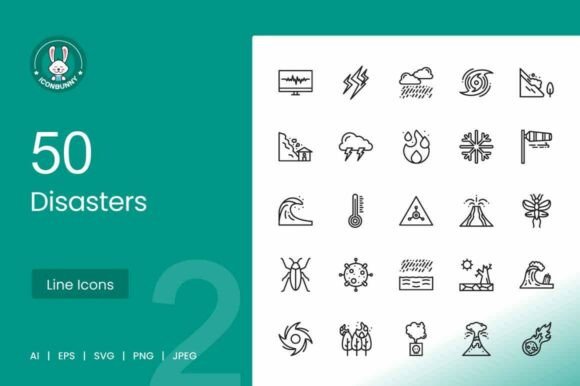
50 Disasters Icons: Visual Communication for Emergency Preparedness and Response
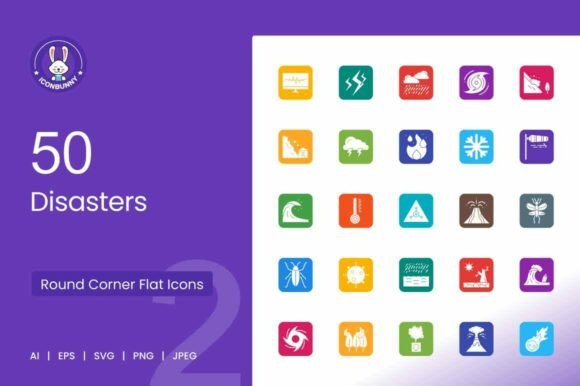
When emergencies strike, clear communication can mean the difference between confusion and coordinated action. The challenge of conveying complex disaster scenarios quickly and universally has led to the growing adoption of standardized visual tools. Among these, the 50 Disasters Icons collection stands out as a comprehensive resource designed to bridge gaps in understanding across languages, cultures, and professional domains. The set encompasses both natural calamities like earthquakes, floods, hurricanes, wildfires, volcanoes, tsunamis, landslides, droughts, and storms, as well as human-caused incidents such as explosions, power outages, and emergency alerts. The scope of coverage makes it a versatile asset for anyone involved in risk communication.
The Rationale Behind a Comprehensive Disaster Icon Set
The decision to compile fifty distinct symbols into a single collection reflects a deeper understanding of how emergencies unfold. No disaster exists in isolation. A hurricane may trigger flooding, which in turn can cause landslides and power outages. Having access to a coordinated set of icons allows designers, educators, and emergency managers to represent chains of events realistically. The 50 Disasters Icons set provides this interconnected visual vocabulary, enabling users to build scenarios that mirror real-world complexity. The clean and modern vector styling ensures that each symbol remains legible at various sizes, from mobile app interfaces to large presentation screens.
Another practical advantage lies in the sheer breadth of representation. Traditional icon packs often focus solely on weather-related events or generic warning signs. This collection intentionally includes less frequently depicted but equally critical events such as explosions and volcanic activity. By doing so, it serves audiences in geologically active regions, industrial zones, and urban centers where infrastructure failures pose significant risks. The inclusion of a dedicated emergency alert icon further enhances its utility for alert systems and public safety announcements.
Vector Technology and Design Consistency
The technical foundation of the 50 Disasters Icons set deserves attention. Each icon is delivered in multiple formats: AI, EPS, SVG, PNG, and JPG, with a resolution of 1024×1024 pixels at 72 DPI. This format diversity ensures compatibility across workflows. Designers working in Adobe Illustrator or Affinity Designer can open the AI and EPS files directly, while web developers and UI designers will appreciate the SVG format for its scalability and small file size. The PNG and JPG versions offer immediate use for presentations, documents, and social media graphics without requiring additional software.
The well-organized layers within each vector file represent a thoughtful approach to usability. Rather than merging all elements into a single flattened shape, the icons are structured so that individual components can be recolored, resized, or repositioned independently. This feature proves valuable when adapting the icons to match brand color schemes or when creating light and dark mode variations for apps. A disaster preparedness app targeting first responders might use high-contrast orange and black variants, while an educational platform aimed at children could employ softer pastel tones. The layered structure accommodates both scenarios without requiring a redesign from scratch.
Primary Applications Across Professional Domains
The practical applications of this icon set extend far beyond simple decoration. In the field of emergency management, these icons serve as building blocks for situational awareness dashboards. Mapping platforms that track real-time incidents can use the earthquake icon to mark seismic activity, the flood icon to highlight inundated areas, and the wildfire icon to denote active burn zones. When combined on a single interface, these visual cues allow responders to assess threats at a glance, reducing cognitive load during high-stress situations.
Educational institutions represent another significant user group. Disaster preparedness curricula often rely on worksheets, posters, and digital modules that introduce students to various hazards. The 50 Disasters Icons collection provides educators with ready-made visuals that maintain consistency across learning materials. A lesson on tectonic plate movements can incorporate the earthquake and tsunami icons, while a unit on weather patterns can draw from the hurricane, storm, and drought symbols. The ability to reuse the same icons across handouts, slides, and online quizzes reinforces recognition and retention.
News media outlets also benefit from having a dedicated disaster icon library. In breaking news coverage, time is scarce. Journalists and graphic designers can quickly locate the relevant icon—be it for a landslide in a mountainous region or a power outage affecting a metropolitan area—and integrate it into broadcast graphics, article headers, or social media cards. The professional design ensures that these visuals meet editorial standards, avoiding the amateurish appearance of hastily sourced clip art.
Humanitarian and NGO Use Cases
Non-governmental organizations operating in disaster response and humanitarian aid frequently produce informational materials for affected communities. These materials must communicate vital safety instructions across language barriers. Icons function as a universal language in such contexts. A poster illustrating evacuation routes can use the fire icon to indicate danger zones and the emergency alert icon to mark assembly points. The 50 Disasters Icons set allows humanitarian teams to create culturally neutral visuals that avoid reliance on text, which may not be understood by all community members.
Furthermore, fundraising campaigns and awareness drives rely on emotional yet accurate imagery. The drought icon, for instance, can accompany statistics about water scarcity, while the storm icon can illustrate the frequency of extreme weather events linked to climate change. By using consistent iconography across reports, websites, and social media, organizations build visual coherence that strengthens their messaging. Donors and stakeholders come to associate specific symbols with specific causes, enhancing recognition and recall.
Workflow Integration and Customization Potential
Integrating the 50 Disasters Icons into existing projects requires minimal friction. The SVG files can be imported directly into web design tools like Figma and Sketch, where they become fully editable vector objects. Developers working with React, Vue, or Angular can treat each SVG as a component, adjusting properties such as fill color, stroke width, and opacity through code. This approach enables dynamic theming based on user preferences or context. For instance, a mobile app might display the explosion icon in red when a critical alert is active, then revert to gray when the situation stabilizes.
For print applications, the high-resolution PNG and JPG files ensure crisp output at 1024×1024 pixels. Brochures, flyers, and training manuals can incorporate these icons without pixelation, even when printed at large sizes. The 72 DPI resolution is standard for screen use, but the vector formats allow for upscaling to 300 DPI for professional printing when needed. Users who require higher print resolutions can simply open the AI or EPS files and export at their desired settings.
Another workflow advantage lies in the organization of the files. The collection includes individual files for each icon across all five formats, making it straightforward to locate and use specific symbols. A designer building a disaster timeline infographic can drag the earthquake, tsunami, and landslide icons directly into the canvas without searching through a single oversized file. This modular structure saves time and reduces errors compared to working with monolithic asset sheets.
Considerations When Using Disaster Iconography
While the benefits of using a dedicated disaster icon set are clear, certain considerations deserve attention. Context matters when deploying these symbols. The same icon that effectively communicates danger in an emergency alert app might cause unnecessary alarm in a casual educational context. Designers should pair icons with appropriate color coding, labels, and explanatory text to ensure the intended message is conveyed without ambiguity. For example, a lightning bolt symbol could represent a storm, a power surge, or an electrical hazard depending on surrounding elements. Contextual framing resolves such ambiguity.
Cultural sensitivity also plays a role. Some communities may interpret certain symbols differently based on local experiences or traditions. The volcano icon, while geographically specific, may hold particular resonance in regions like the Pacific Ring of Fire. Similarly, the drought icon might evoke stronger emotions in areas currently experiencing water shortages. Awareness of the audience helps avoid unintended distress or misinterpretation.
Accessibility standards should guide implementation as well. Icons used in digital interfaces require appropriate alt text for screen readers. A simple description like "icon representing an earthquake" ensures that visually impaired users receive the same information as sighted users. Color contrast ratios must meet WCAG guidelines, especially when icons appear on colored backgrounds. The clean vector outlines of the 50 Disasters Icons set support high contrast by default, but testing against specific background colors remains good practice.
Comparative Advantages Over Generic Icon Libraries
Generic icon collections available through free or subscription services often lack the specificity needed for disaster-related projects. A general-purpose set might include a single "storm" icon but omit critical variants like "tsunami" or "landslide." The 50 Disasters Icons collection fills these gaps by offering dedicated symbols for each major disaster type. This depth allows storytellers and communicators to represent events accurately rather than forcing them to repurpose inappropriate symbols.
Another advantage lies in the visual consistency across the set. Icons designed by different authors or sourced from disparate libraries often vary in stroke weight, corner radius, and stylistic approach. Mixing them within a single project creates visual dissonance that undermines professionalism. The unified design language of this collection ensures that an earthquake icon and a wildfire icon feel like members of the same family, even when used side by side. This coherence matters in polished deliverables such as client presentations, published infographics, and public-facing safety materials.
The licensing terms also deserve mention. Purchasing a premium set typically grants broader usage rights compared to free alternatives, which may restrict commercial use or require attribution. For businesses, agencies, and nonprofits that need to incorporate icons into revenue-generating products or client work, the clarity of ownership reduces legal risk. The 50 Disasters Icons set provides a straightforward path to compliant use without worrying about attribution clauses or usage caps.
Future Trends in Disaster Visualization
The role of iconography in emergency communication is likely to expand as new technologies emerge. Augmented reality applications, for instance, can overlay disaster icons onto real-world camera feeds to indicate hazards in the user's immediate environment. A hiker navigating near a wildfire zone might see a fire icon superimposed on the landscape through their phone screen. The clean vector format of these icons makes them suitable for real-time rendering in AR and VR environments, where performance and clarity are paramount.
Data journalism and interactive storytelling also stand to benefit. News organizations increasingly use scrollytelling formats where readers progress through a narrative accompanied by dynamic visuals. Disaster icons can punctuate key moments in such stories, such as the moment a hurricane makes landfall or the aftermath of an explosion. The ability to animate SVG icons—changing colors, adding motion, or revealing details—opens creative possibilities without sacrificing consistency.
Educational gamification represents another frontier. Serious games that simulate disaster response scenarios require visual assets that distinguish between different event types. Students tasked with allocating resources after an earthquake must recognize the earthquake icon on a map, just as they must identify the fire icon when deciding where to deploy firefighters. The 50 Disasters Icons set provides the visual vocabulary needed for such interactive learning experiences.
The growing emphasis on climate resilience and sustainable development will continue to drive demand for accurate disaster communication tools. As extreme weather events become more frequent and communities invest in preparedness infrastructure, the need for clear, shareable, and universally understood visuals will only intensify. Icon sets that combine breadth of coverage with professional design will remain essential resources for the people and organizations working to keep others safe.