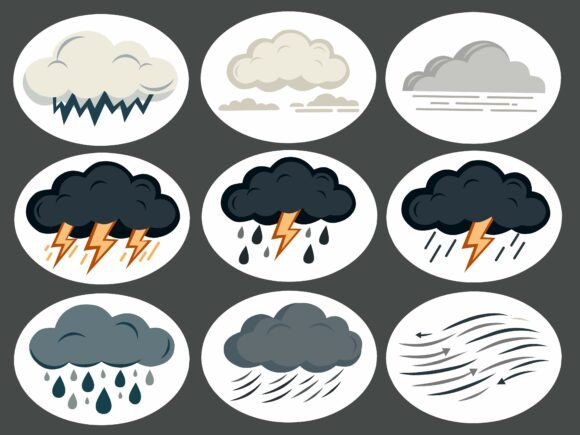
Elevate Your Visual Storytelling with a Rainy Weather Clipart Set
Why Weather Graphics Matter in Digital and Print Design
Weather is one of the few universal experiences that connects people across geographies, seasons, and moods. Whether it is a gentle spring drizzle or a dramatic thunderstorm, atmospheric conditions evoke emotion, set a scene, and communicate information quickly. This is why weather-themed visuals appear everywhere—from mobile apps showing the day's forecast to educational materials teaching children about precipitation, and from printable planners tracking weekly weather patterns to digital scrapbooks preserving memories of cozy rainy days.
A thoughtfully designed rainy weather clipart set does more than simply depict raindrops or clouds. It captures the feeling of wet pavement, the tension before a storm, and the calm after the rain passes. When you incorporate a cohesive collection of weather icons into your project, you bring a layer of visual polish and emotional resonance that a generic icon simply cannot deliver. The right set saves design time, maintains consistency, and helps your audience instantly grasp the mood or message you intend to convey.
Visual Language and Design Philosophy
The rainy weather icon set described here adopts a modern flat illustration approach with deliberate soft shading and smooth outlines. Unlike overly detailed or hyper-realistic weather graphics, this collection leans into simplicity while preserving enough visual texture to feel complete and engaging. The muted grey-blue tones are carefully chosen to reflect overcast conditions without becoming drab. Storm clouds carry a weight that signals unsettled weather, lightning flashes pierce the palette with sharp contrast, and drizzle patterns trail downward with a gentle rhythm that mimics real rain.
What makes the set particularly effective for cross-platform use is the balance between stylized abstraction and instant readability. A lightning bolt is immediately recognizable, but the rounded corners and subtle gradients give it a friendly, approachable character. This makes the icons suitable for children's educational worksheets one day and polished UI elements for a professional weather dashboard the next. The visual cohesion across all nine elements means that whether you use one icon or the entire set, the design language remains consistent.
Color Psychology and Atmospheric Tone
Color plays a pivotal role in how weather graphics are perceived. The muted grey-blue palette anchors the set in a calm, slightly contemplative mood. Lighter tones suggest mist and light rain, while deeper shades evoke heavy clouds and approaching storms. This range allows designers to layer icons to create narratives—a light drizzle icon paired with a partly sunny symbol might indicate changing conditions, while a dark storm cloud with lightning clearly communicates a weather alert. The rainy weather clipart set is versatile enough to support both informational clarity and emotional storytelling.
Digital Product Design and UI/UX
For interface designers working on weather apps, lifestyle planners, or environmental dashboards, a consistent icon set is essential. Each icon here is built with smooth outlines and a uniform visual weight, so scaling them for small buttons or larger hero sections does not break readability. The included SVG and EPS vector formats allow for infinite scaling without quality loss—critical when icons must render crisply on retina displays or adapt to responsive layouts.
Consider a weather app that needs to show hourly forecasts. Instead of using a single generic raindrop icon for all precipitation, the set offers drizzle patterns alongside heavier raindrops and storm clouds. This subtle differentiation helps users quickly scan conditions without reading text. Similarly, UI elements like wind lines can indicate breeze strength in a way that feels intuitive and visually interesting. The transparent PNG files are ready to drop into mockups, prototypes, or final builds without extra editing.
Educational Materials and Worksheets
Educators and homeschooling parents frequently need visuals that explain natural phenomena in an accessible way. A rainy weather clipart set with clear, uncluttered icons helps young learners identify different weather types, understand seasonal patterns, and build vocabulary. Worksheets about the water cycle become more engaging when students can label storm clouds, raindrops, and wind lines. The flat style without excessive detail keeps the focus on the concept rather than decorative flourishes.
Teachers can also combine multiple icons to create sorting activities—asking students to group symbols into rainy, windy, or stormy categories. Because the set is cohesive in style, these exercises look polished and professional rather than patched together from disparate sources. For science units on weather forecasting, the clipart can anchor bulletin board displays, flashcards, or interactive notebooks. The JPG preview image serves as a handy reference sheet for lesson planning.
Printable Planners and Organizational Tools
Printable planner communities value functional aesthetics. Weather icons in planners help users track moods, plan outdoor activities, or note significant weather events. The muted grey-blue tones pair beautifully with neutral planner layouts, minimalist designs, or bullet journals. A small storm cloud next to a date might remind the user to carry an umbrella, while a lightning icon could mark a power outage or memorable thunderstorm.
Because the icons are provided as individual PNG files with transparent backgrounds, they can be resized and placed anywhere on a planner page without clashing with other elements. Digital planner creators can import the SVG files into annotation apps and use them as reusable stickers. The soft shading gives each icon a subtle dimensionality that feels tactile on both screen and paper. For printed planners, the JPG preview can serve as a sticker sheet guide when cutting individual elements by hand or with a die-cutting machine.
Digital Scrapbooking and Memory Keeping
Weather often frames personal memories—the rainy afternoon you spent reading by the window, the stormy night of a family gathering, or the first spring rain after a long winter. Digital scrapbookers frequently turn to weather clipart to anchor layouts with mood and context. A rainy weather clipart set that includes lightning, drizzle, and wind lines allows the creator to layer atmospheric elements that tell a richer story than a photo alone.
For example, a scrapbook page documenting a trip to the coast might use a soft rain cloud and angled drizzle to suggest a misty morning beach walk. A page about a cozy indoor day could pair raindrops with a warm color palette. Because the icons are modern and clean, they integrate easily with both vintage-inspired and contemporary scrapbooking styles. Transparent PNGs enable precise layering without awkward white boxes around each element.
Posters, Infographics, and Climate Communication
Climate infographics and weather-related posters require visuals that are immediately understandable across diverse audiences. The icons in this set serve as building blocks for larger visual narratives. A poster about seasonal rainfall patterns might use the drizzle and heavy rain icons as data markers along a timeline. An infographic about thunderstorm safety could feature the lightning icon as a visual anchor for key warning points.
The vector formats (EPS and SVG) are especially valuable for large-format printing. Poster designers can scale a single storm cloud to fill a background area or repeat raindrop icons across a banner without pixelation. The soft shading and muted tones prevent the graphics from feeling overly aggressive or distracting, which is important when the content carries educational or safety messaging. Nonprofit organizations, government agencies, and environmental groups can use these icons to create materials that feel polished without requiring a large design budget.
File Formats and Workflow Integration
Having multiple file formats within one set removes common friction points. The EPS file is ideal for professional vector editing in software like Adobe Illustrator or CorelDRAW, allowing full customization of colors, sizes, and arrangements. The SVG file works seamlessly in web development, UX prototyping tools like Figma or Sketch, and modern design applications that support scalable vector graphics.
The nine individual PNG files with transparent backgrounds are ready for immediate use in document editing tools, presentation software, or image compositing. They are particularly helpful for users who do not work with vector software but still need clean, cut-out graphics. The JPG preview image acts as a quick reference to see the entire set at a glance—useful for client approvals, thumbnail selection, or inventory management. This format variety ensures that whether you are a professional designer, a teacher, or a hobbyist, you can work with the files in your preferred environment without conversion headaches.
Print vs. Digital: Aligning Resolution and Color
When using the clipart for print projects, consider that the vector files (EPS and SVG) are resolution-independent and will output at any size with perfect sharpness. The PNG files are provided at a resolution suitable for standard digital use; for large print outputs, it is recommended to start from the vector source to ensure crisp edges. The muted grey-blue color palette is designed to translate well to both screen and ink, though you may want to test a small sample if matching exact brand colors is critical.
For digital applications, the transparent PNGs load quickly and layer easily over photos, gradients, or colored backgrounds. Because the icons feature soft shading, they already carry a degree of depth that reduces the need for additional drop shadows or effects. This simplicity speeds up design workflows and keeps file sizes manageable for web use.
Building Weather Narratives with Icons
One of the strengths of a cohesive clipart set is the ability to sequence icons into a visual story. A single storm cloud is static, but place it alongside a lightning bolt, angled drizzle, and wind lines, and you have created a weather scene that suggests movement and change. Designers can use this to illustrate weather transitions in explainer videos, timeline graphics, or interactive digital content.
For content creators building social media templates, the icons can serve as recurring visual motifs across a series of posts. A weekly weather roundup, for instance, could use different combinations of the icons to indicate each day's conditions. The consistent style reinforces brand identity while the varied elements keep each post visually fresh. Even simple animations—such as a raindrop icon that fades in and out or a wind line that oscillates slightly—can be achieved by layering the provided PNGs or vector paths in motion design software.
Cross-Disciplinary Use in Research and Communication
Researchers and communicators in fields like climatology, geography, or urban planning often need simple visuals to present complex data to non-specialist audiences. A rainy weather clipart set can transform a dry statistics table into an engaging infographic. For example, a bar chart showing monthly precipitation becomes more approachable when each bar is topped with a miniature rain cloud or drizzle icon. Lightning symbols can mark months with high thunderstorm frequency.
Because the icons are designed without extraneous detail, they do not compete with data visualization elements. Instead, they serve as intuitive labels that help viewers process information faster. This aligns with research in cognitive science showing that visual anchors improve recall and comprehension of numerical data. The same principle applies in classroom settings, where students can create their own weather journals, tracking daily conditions by selecting and pasting the appropriate icon.
Considerations for Selecting a Weather Icon Set
When evaluating any clipart collection for professional or personal use, several factors determine long-term value. First, stylistic consistency across all elements is non-negotiable—mismatched line weights or shading styles break the visual harmony of a project. The set described here maintains uniform outline thickness, consistent corner rounding, and a shared color palette, ensuring that any combination of icons feels intentional.
Second, the range of weather conditions covered should match the scope of your intended projects. A set limited to simple rain drops may suffice for basic tasks, but the inclusion of storm clouds, lightning, wind lines, and varied drizzle patterns opens up richer storytelling and more precise communication. The nine icons provide enough diversity to cover the most common rainy weather scenarios without overwhelming the user with excessive options.
Third, the availability of vector formats alongside ready-to-use PNGs directly impacts workflow flexibility. Users working across different devices or collaborators using different software benefit from having both editable and static formats. The EPS and SVG files allow for color adjustments, combination with other vector elements, and rescaling without degradation. The PNGs serve as quick placeholders or final assets for users who need a drag-and-drop solution.
Finally, consider the aesthetic tone. The muted, modern flat style with soft shading occupies a sweet spot between playful and professional. It fits equally well in children's learning apps and corporate presentations. This versatility reduces the risk of the icons feeling out of place if your design direction shifts over time.
Making the Most of Your Rainy Weather Clipart Set
To extract maximum value from this collection, think beyond obvious weather forecasting contexts. Use the drizzle icon as a background pattern element by repeating it at low opacity across a page. Layer the wind lines over a photograph to suggest motion. Combine the lightning icon with typography for a bold poster headline. The muted color palette makes the icons excellent accent pieces that can be paired with bolder colors for contrast or kept monochromatic for a unified look.
For digital product creators, consider building interactive elements where users tap or click on different icons to reveal weather facts or forecasts. The clean visual style ensures the icons remain legible at interactive sizes. For educators, the set can be incorporated into digital whiteboard activities, where students drag and drop the correct weather symbol onto a location or date.
The true value of a well-designed icon set lies not just in the individual graphics but in the creative possibilities they unlock. When you start seeing a storm cloud not just as a symbol but as a character, a mood, or a narrative device, the set becomes a toolkit for visual communication far beyond its original purpose.