Why a Brand Guideline Google Slides Template Is Essential for Modern Professionals
In an era where first impressions are often formed through a screen, the way a company presents itself visually has never been more critical. Brand consistency is no longer a luxury reserved for large corporations with dedicated design teams. It is a fundamental expectation from clients, partners, and audiences who interact with businesses across multiple touchpoints. The challenge for many professionals, entrepreneurs, and creators is not a lack of vision but a lack of accessible, structured tools to execute that vision consistently. Enter the Brand Guideline Google Slides Template, a resource that bridges the gap between ambitious branding goals and practical, everyday implementation.
This article explores why this template has captured the attention of marketers, freelancers, and business leaders, and how it fits into larger shifts in how we communicate, collaborate, and build trust in a visually saturated world.
The Growing Demand for Visual Brand Discipline
Brand guidelines have long been the backbone of corporate identity. They dictate everything from logo placement and color palettes to typography and imagery style. Traditionally, these guidelines were housed in expensive, printed booklets or complex PDFs that required specialized software to edit. The modern professional, however, works differently. Teams are distributed, timelines are compressed, and presentations are the currency of ideas.
The Brand Guideline Google Slides Template arrives at a moment when the line between internal documentation and external communication is blurring. A brand guideline is no longer just a reference document tucked away in a server. It is a living tool that teams use to pitch ideas, onboard new members, and present brand strategy to stakeholders. By packaging these guidelines into a Google Slides format, the template makes brand governance accessible, editable, and collaborative in real time.
This shift reflects a broader trend toward democratized design. Tools once reserved for graphic designers are now being used by project managers, founders, and content creators. The template empowers these professionals to produce polished, coherent brand materials without needing to master complex design software. It meets the market where it is: collaborative, cloud-based, and fast-paced.
Why Professionals Are Paying Attention
Several converging factors explain the rising interest in structured brand presentation templates, particularly those built for Google Slides.
Consistency Across Distributed Teams
Remote and hybrid work models have made brand consistency harder to enforce. When team members are spread across time zones and use different devices, maintaining a unified visual identity becomes a logistical challenge. A Brand Guideline Google Slides Template acts as a single source of truth that everyone can access and contribute to. It reduces the friction of sending files back and forth and eliminates the risk of outdated versions being used in client-facing decks.
For example, a marketing manager at a growing startup can use the template to ensure that every sales presentation, investor deck, and social media proposal follows the same color scheme and typography. This consistency builds familiarity and trust with audiences over time, which is especially valuable for smaller brands competing against established players.
Speed Without Sacrificing Quality
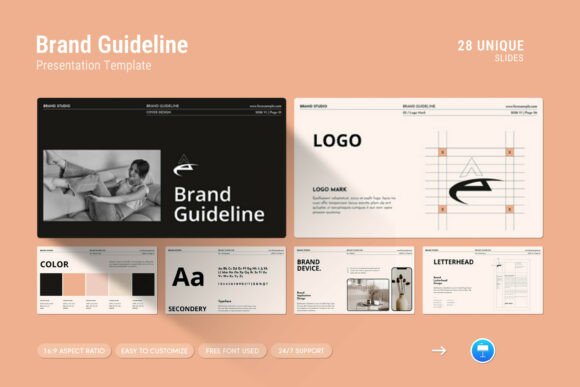
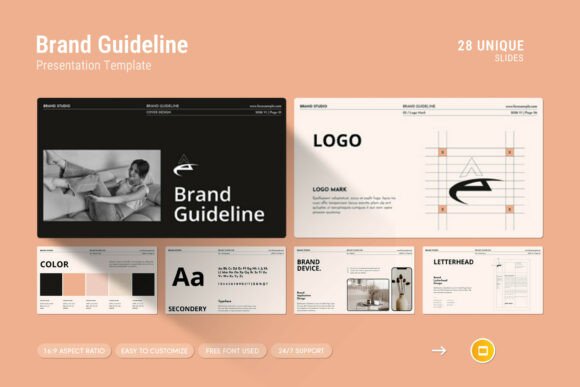
Time is a scarce resource for entrepreneurs and freelancers. Creating a brand guideline from scratch can take days or even weeks. The Brand Guideline Google Slides Template provides a head start with pre-built layouts, infographics, and vector icons that can be customized in minutes. This efficiency does not mean sacrificing quality. The design is contemporary and clean, allowing professionals to present their work at a high level without investing excessive hours into formatting.
Consider a freelance brand strategist who needs to deliver a comprehensive brand identity document to a client. Instead of piecing together slides from scratch, they can use the template to showcase mood boards, typography hierarchies, color codes, and logo usage rules in a visually compelling way. The result is a professional deliverable that elevates their credibility and saves billable hours for strategy and creative work.
The Rise of Visual Literacy in Business
Audiences today are more visually literate than ever. They expect information to be presented clearly and attractively. This expectation has permeated every level of business communication, from internal memos to investor pitches. The Brand Guideline Google Slides Template is designed with a 16:9 Full HD ratio (1920x1080px), ensuring that presentations look sharp on modern screens and projectors. The inclusion of diagrams, tables, and infographic elements allows professionals to communicate complex brand rules in an intuitive, scannable format.
This aligns with a broader movement toward visual thinking in business. Data alone is not enough; it must be contextualized and presented in a way that resonates. The template supports this by offering structured layouts for presenting brand architecture, competitor analysis, and audience personas. It turns abstract brand concepts into tangible, visual narratives.
Redefining the Workflow for Creators and Marketers
The Brand Guideline Google Slides Template is not just a collection of slides. It is a reflection of how modern professionals prefer to work. The drag-and-drop functionality for changing images, the easy color change features, and the master slide layouts all point to a workflow that prioritizes flexibility and speed.
This approach resonates strongly with content creators who manage multiple brands or projects. A YouTuber or content entrepreneur, for instance, may need to present a brand kit to potential sponsors or collaborators. Using this template, they can quickly assemble a professional-looking brand guideline that communicates their channel's visual identity, tone, and usage rules. This not only impresses partners but also protects the brand from inconsistent representation across platforms.
For marketers, the template serves as a bridge between creative teams and business stakeholders. When presenting a rebrand or brand refresh, the template's clean design and logical flow help non-designers understand the rationale behind visual choices. The use of infographics and diagrams makes the data more persuasive and reduces the likelihood of subjective feedback derailing a strategic direction.
Practical Observations from the Field
Having observed how various professionals adopt structured templates, several patterns emerge. First, those who invest time upfront in customizing a brand guideline template tend to experience smoother collaborations down the line. When every team member knows exactly which font to use and what shade of blue represents the brand, decision-making becomes faster and less prone to error.
Second, the best brand guidelines are not static. They evolve as the brand grows. The Google Slides format supports this iterative nature. Updates can be made instantly, and the latest version is always available to anyone with the link. This is a significant improvement over printed documents or locked PDFs that require a formal revision process every time a color palette shifts or a new logo variant is introduced.
Third, the template's compatibility across Apple and Windows devices removes a common barrier to adoption. In mixed-device environments, a universal tool like Google Slides ensures that everyone can participate in building and using the brand guideline. This inclusivity is crucial for fostering brand ownership across an organization.
Connecting to Larger Developments
The emergence of tools like the Brand Guideline Google Slides Template is part of a larger narrative about the commoditization of professional design. As artificial intelligence and cloud-based tools continue to lower the barrier to entry, the ability to produce high-quality visual communications is no longer limited to those with formal design training. This is both an opportunity and a responsibility. Professionals must now focus not just on creating visually appealing materials but on ensuring that those materials are strategically coherent.
In this context, brand guidelines become a form of strategic alignment. They ensure that every visual element supports the brand's positioning, values, and goals. The template facilitates this alignment by providing a structured framework that guides users through the essential components of a brand identity. It prompts them to think about logo usage, color psychology, typography hierarchy, and imagery style in a systematic way.
Furthermore, the template's inclusion of vector icons and infographics speaks to the growing importance of data visualization in brand communication. Audiences increasingly expect to see information presented in digestible, visual formats. A brand guideline that incorporates these elements sets a standard for how the organization communicates not just its identity but its ideas.
Final Thoughts
The Brand Guideline Google Slides Template is more than a design asset. It is a response to the evolving needs of a workforce that demands speed, collaboration, and consistency. For professionals who build brands, present ideas, or manage creative projects, it offers a practical path to visual discipline without the overhead of traditional design workflows.
As the marketplace becomes more crowded and attention spans shorter, the brands that succeed will be those that communicate with clarity and coherence. The template provides a foundation for that clarity, enabling anyone from a solopreneur to a marketing team to present their work with confidence. In a world where perception often precedes reality, having a polished, consistent brand identity is not just an advantage. It is a necessity.
By embracing tools that make brand governance accessible and adaptable, professionals position themselves to respond quickly to opportunities, build trust with their audiences, and focus their energy on what truly matters: the ideas and values that their brand represents. The Brand Guideline Google Slides Template is a step in that direction, and its growing popularity reflects a collective recognition that good design and good business are inseparable.